
by Anthony (Tony) Haverty and Nick Lamparelli
August 2026
A decade ago, when an underwriter entered an incorrect number or misread a file, the damage was contained to one policy. One person, one mistake, one fix.
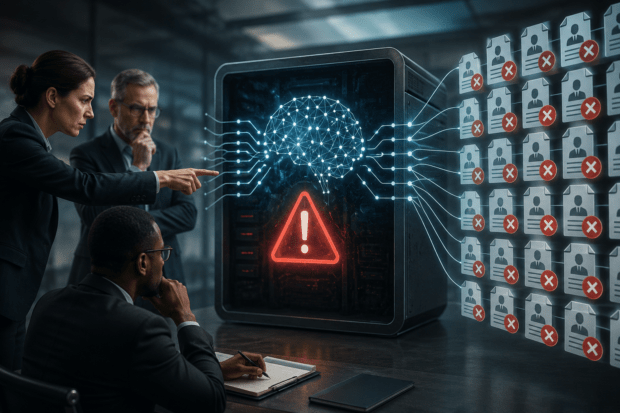
Today, a single flaw in a model’s logic or a bad software update can repeat the same mistake across thousands of policies before anyone notices. The error moved from the person to the architecture. And when the failure lives in the architecture, it happens everywhere at once.
We spend our days inside the operational layer, where these systems run for global and regional carriers and MGAs, and the most common question we hear from underwriting leaders is, “Will AI replace my underwriters?” A more useful question: who is governing the systems my underwriters now depend on?
Architectural Risk is the New Exposure
Underwriting has been and currently is right-in-the-crosshairs of change. We got a glimpse of this change in the prior decade, as some underwriting teams began modernizing across the value chain. Applying machine learning to triage submissions and score renewal risk, while also investing in third-party data validation to fuel those models. The real judgement work, especially in the specialty and commercial lines, is still done by humans. Everyone assumed that if something went wrong, a person had made a mistake.
Today, that assumption is outdated.
Agentic AI systems ingest broker submissions, pull outside data, flag information gaps, and assemble decision packages before a human ever opens the file. The output of one automated process becomes the input for the next. Speed goes up and so does the blast radius of any single flaw.
This is the architectural risk, and it changes what an underwriting organization has to be good at doing. A perfectly careful underwriter working downstream of a corrupted data feed or a mispriced model produces confident, well-documented, wrong decisions at scale. The risk moved upstream, from operator actions to system design, and oversight has to move with it. Underwriters must pivot from focusing on individual operator actions to evaluating workflows and governance for the system put in place at scale.
The New Role: Governance Stewards
If AI acts as the engine for processing, the underwriter serves as the control plane. Part of the role evolves into what I’d call a governance steward, with three responsibilities that are more operational than most underwriting job descriptions have ever been:
- Audit the architecture: Treat your automated workflows the way you’d treat a new program. Test them against failure before failure finds you. That looks like maintaining a library of edge-case submissions and running them through the system after every model or software update, sampling exceptions weekly rather than annually, and monitoring for drift between what the model was trained on and what the market is actually sending you.
If your team can’t tell you when the system was last stress-tested and what broke, the audit function has yet to be built. - Assign ownership: Ensuring every automated decision has a clear human owner who can intervene when the system encounters a situation it doesn’t understand. This sounds obvious and is almost never implemented well. It requires escalation paths with actual SLAs, decision logs that record why the system did what it did, and clear authority for the owner to pull a class of decisions back to manual review without a committee meeting.
Regulators, reinsurers, and courts will all want a name attached to the decision. “The system decided” will fail in every one of those conversations. - Authenticate inputs: As more of the submission chain runs through AI on both sides, verifying data authenticity becomes an underwriting task. Broker submissions increasingly arrive pre-processed by someone else’s AI, which means fabricated or hallucinated data points can enter your workflow looking perfectly clean.
Source verification protocols at intake, spot-checks against primary records, and a healthy suspicion of data that arrives too tidy are now part of the job.
These controls exist today. They are being built right now inside our operations, usually by small teams learning as they go. The organizations getting it right treat governance as a designed workflow with owners, checkpoints, and documentation. The ones getting it wrong treat it as a policy memo.
The Arbitrage: Humans Price What History Missed
Arbitrage in the insurance industry refers to the ability to see value where others do not. In the AI era, this value lies in the underwriter’s ability to bridge the gap between static model logic and a dynamic risk landscape. Models run on historical data, and the world keeps producing exposures the data never saw. Extreme weather, geopolitical conflicts, and technological shifts create new risks that historical data cannot predict.
AI models often struggle to adapt to these new scenarios. The human underwriter provides the necessary context to keep the model accurate. If a model underprices risk because it does not account for a change in climate, the human underwriter is the only one capable of spotting the pattern before it affects underwriting results.
This makes model maintenance a core underwriting function. As the risk landscape changes, underwriters must update the guidelines and the underlying logic of the software. They define the dynamic decision-making logic rather than simply following a static set of rules. That feedback loop, human judgement continuously training the engine, is what keeps an AI-assisted book accurate.
Back To the Future of Underwriting
Decades ago, underwriters were gatekeepers to capacity. They built relationships with insurance buyers who could provide exposures that met the carrier’s criteria. Underwriters used to be the carrier’s salespeople and account managers. In the prior two decades, however, underwriting has lost its way.
The next decade reverses that. Fewer people will do routine underwriting tasks. That reduction is already underway, and pretending otherwise helps no one. Underwriters will supervise agentic workflows, a task that will require deep and intimate knowledge of risk, insurance, and information arbitrage. Additionally, underwriters will be expected to develop, nurture, and maintain relationships with the marketplace to generate the inbound activity that makes a carrier financially effective. The task work goes to the machines. The strategy, the workflow design, the engine training, and the relationships stay with humans.
For the underwriters able to make the shift, this is a better outcome than their current situation: they will be liberated from repetitive work, resulting in fewer errors, greater efficiency, and a clearer, more significant impact on their businesses’ effectiveness.
CONTRIBUTORS
Anthony (Tony) Haverty, Senior Vice President Operations at FOCUS.
Nick Lamparelli is a nearly three-decade insurance professional in the property and casualty space. Lamparelli is a two-time MGA co-founder and currently serves as the Chief Programs Officer for Algorithmic Insurance Services. He is also the Managing Partner of Insurance Nerds, a media and marketing firm focused on educating the next generation of Insurance Professionals.
###
About FOCUS
FOCUS is an insurance BPO company that provides cloud-based, core administration solutions for P&C insurance companies and MGAs. FOCUS applies decades of insurance experience to developing insurance outsourcing solutions that complement the company’s extensible InFOCUS Platform, including self-service digital portals, configuration tools, and real-time risk management functionality while the FOCUS Insurance Services’ teams deploy policy, billing, and claims solutions with intuitive automation of workflows and artificial intelligence (AI) applications via state-of-the-art cloud technologies and robust APIs. Through proven technology and quality services, FOCUS is taking the risk out of insurtech for small, mid-size, and growth-focused insurance organizations.
Media Contact:
Kim Tambo
Senior Manager, Product Marketing
Focus Insurance Services
Kim.Tambo@teamfocusins.com
http://www.teamfocusins.com