
Why MGT built an insurance carrier from scratch: Michael Topol of MGT Insurance
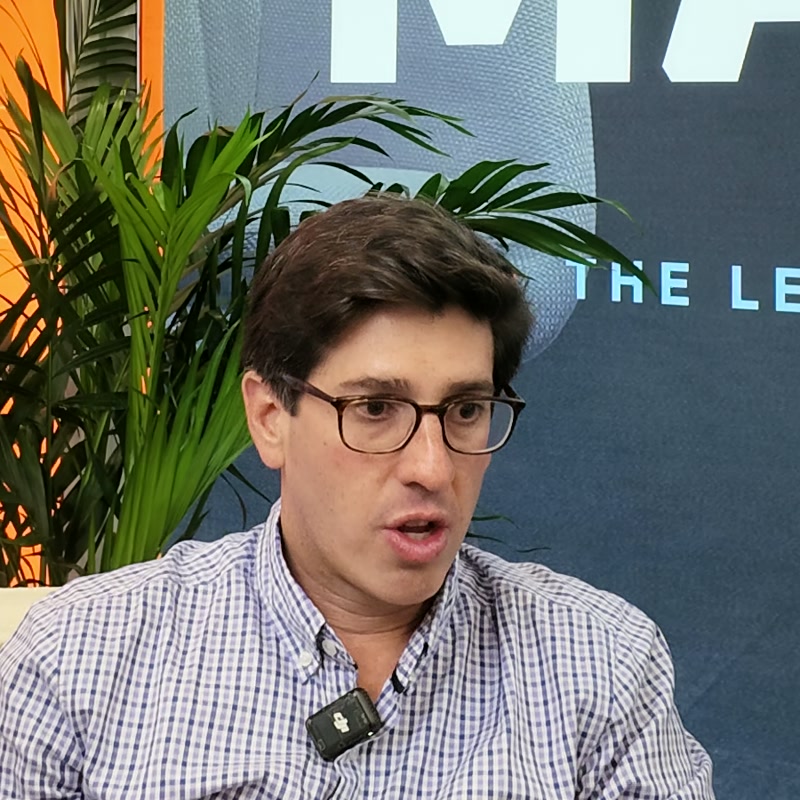
MGT built a commercial P&C carrier from the ground up for small businesses and the independent agents who serve them. In the Policy Makers Studio at ITC Vegas 2026, co-founder and Co-CEO Michael Topol tells FOCUS President Pete Crowe why the carrier was the place to start, how MGT decides what to build and what to buy, and what jobs AI creates in insurance.
The episode at a glance
- 0:47From finance to founding a carrier
- 2:42Why insurance is the best place to apply AI
- 3:22The line at the printer: where workflows break
- 4:40Why small business insurance
- 5:34Making independent agents more profitable
- 7:03A carrier with no legacy platform
- 7:56Building a billing module in six weeks
- 8:33When MGT buys instead of builds
- 10:27Hiring insurance experts and technologists
- 13:25AI as a new way of working
- 14:05Talking to 500 insurers and hundreds of agents
- 15:27Distribution: winning over agents
- 16:42What jobs will AI create in insurance?
Three answers from the episode
Why is insurance the best place to apply AI?
Michael's view: the labs build the models, but for AI to touch the real economy, insurance is probably the best place. The core work of risk selection, pricing and risk management still sits with the carrier, which is why MGT built a carrier from the ground up.
How does MGT decide what to build and what to buy?
From first principles and on speed. MGT buys systems that are flexible and keep up. When its billing vendor couldn't scale with MGT's complexity, the team built its own billing module in four to six weeks, which gave customers and agents more options.
What jobs will AI create in insurance?
Michael sees AI helping people do their jobs better. Taking away data entry and day-to-day minutiae frees up about 80% of that time for talking to customers and solving problems. MGT is hiring faster because it is moving so quickly.
You can't ask them for what the answer is, but you can ask them what their problem is and figure out how to solve it.Michael Topol · MGT Insurance
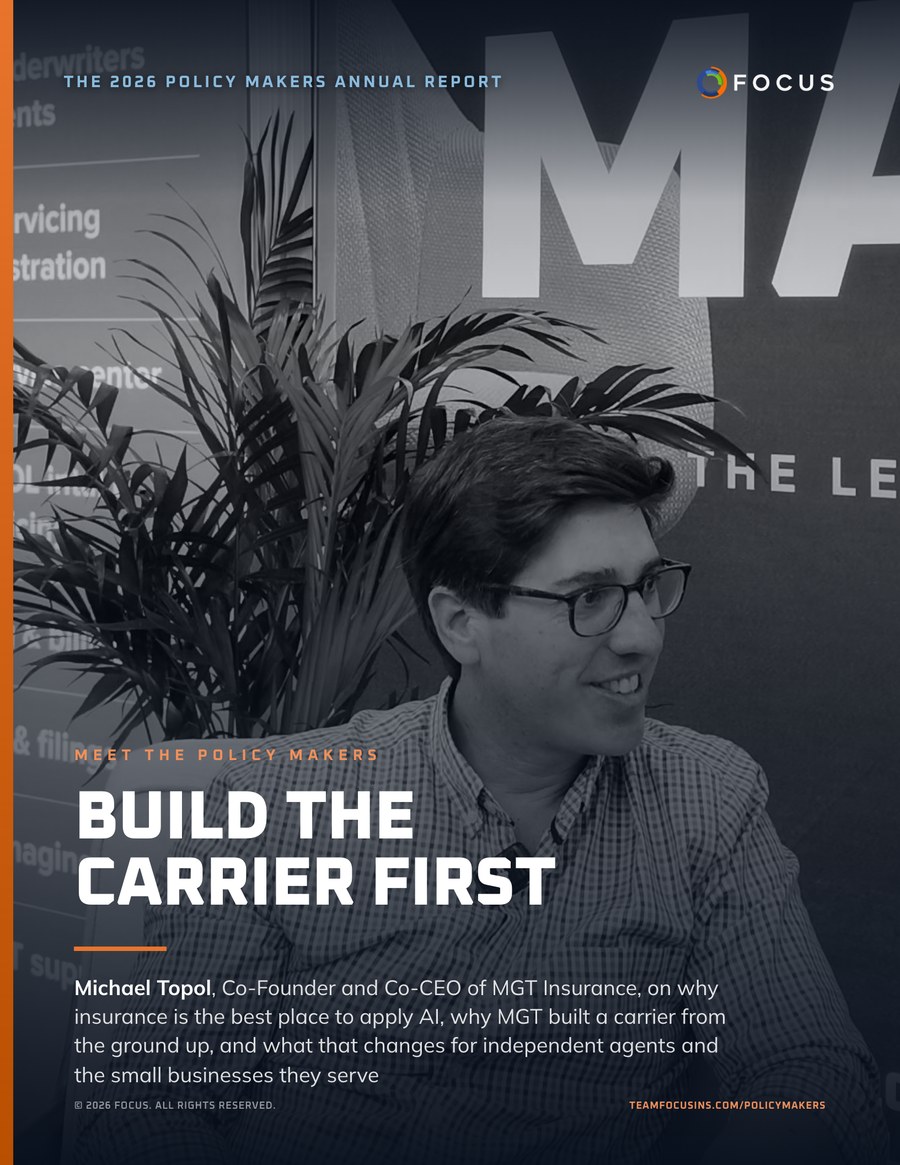
Download Michael's feature: Build the carrier first
Why MGT started with the carrier, how it decides what to build and what to buy, and how it hires for a new way of working. Michael's feature is part of the Studio Edition, the volume of the 2026 Policy Makers Annual Report built from the Meet the Policy Makers interviews.
Get the feature
Your download link appears here as soon as you submit. We'll also email you every published feature and the full report.
Michael's feature is ready
Check your inbox for every published feature and the full report.
Download the feature (PDF)Read the interview
Edited for length and clarity.
Show the full conversation
Pete Crowe: Michael, thanks for joining us. Appreciate you sitting down to talk about the business.
Michael Topol: Pleasure to be here.
Pete Crowe: Let's talk about your background. You know how intros go on a Zoom call: twenty years in the business, and everybody kind of fumbled into it. It's a little different for you and your brother. You came from finance and decided to go all the way in: not an MGA, a carrier. Was there an experience that drove you to that?
Michael Topol: It's a great question. There were several. I started my career in financial services, which had nothing to do with insurance. Then I joined an early-stage insurance technology company in the Bay Area, and I've been in insurance technology for over a decade now. I helped several companies scale, one from 15 to 600 people, and built out functions across those organizations. I've been coming to ITC for seven or eight years. I saw the ways technology could help the insurance industry do things much better, and I also saw the ways software wasn't the answer, and how hard it is to sell technology to the big incumbents. And I found out I really like the insurance industry. Like a lot of people, I fell into it backwards.
My brother had been looking at the industry from the investing side: the MGAs, the insurtech 1.0s and 2.0s. The business models didn't click for him. He didn't think the incentives were aligned, or that those companies were building long-term, sustainable moats and really using technology to be better at their businesses. Then, while I was at Stanford Business School, the large language models arrived, and that was a moment. This technology is going to revolutionize the industry, and it can really be applied.
Pete Crowe: Specifically, you were thinking about insurance.
Michael Topol: Specifically about insurance. I was on a panel with the chief digital officer of one of the largest insurers in the world, and he said something I wholeheartedly agree with: insurance is probably the best place to apply it. We're not building frontier models. The labs are doing incredible work. But for the application of it to touch the real economy, insurance is probably the best place.
My brother also worked at a brokerage during business school, which was trying to use technology to make things better for the policyholder. He likes to tell this story. They had a big industrial printer, and about three months into the job he asked why there was a line at the printer every single day. The answer: they'd spent all this money building technology that made the experience better for the policyholder, but whenever you transact with the carrier, you have to print to mail, scan to fax or, best case, scan to email.
Pete Crowe: That's where it breaks down.
Michael Topol: It still breaks down. That was another aha moment. People are building MGAs, they're building brokerages, they're working on pieces around the ecosystem. But the core functions of risk segmentation, risk selection, risk pricing and risk management still sit with the carrier. If we could build an AI-native carrier from the ground up, we could do two things: apply AI in a way that actually works, including how the organization is designed, and be a much better partner to the independent retail agencies and brokerages serving small businesses.
That's the first answer to your question. The second is why small business. There are 35 million small businesses in this country, and they're the backbone of the American economy. Many have insurance, many are underinsured, and many don't have insurance at all. Insurance is what allows people to be entrepreneurs: to start a business, scale it, and sleep well at night knowing that if something happens, they can rebuild and protect those local jobs and communities. In our minds, insurance is a social and economic good. So our mission is to make it a better experience for the small business owner and, importantly, for the broker who serves them.
Pete Crowe: A good experience, and trust from the start. Now you've built the carrier side. How do you make it work for the brokers and agents, so they want to bring business to you?
Michael Topol: We like working with independent agents, brokers and wholesalers. If you're opening a bait shop, you're not opening it to become an expert in insurance. You want to rely on a trusted advisor. But that advisor has a lot of other customers, and a smaller commercial policy becomes inefficient and unprofitable for them. The servicing time means they can't give you the attention you need, because they're spending their time on paper. So for those brokers and agents, we make the work significantly more efficient and much more profitable, which lets them spend time with their customers. And as the carrier, when a policyholder has real questions, whether that's customer service, billing or claims, we make it a seamless process, so the agent feels comfortable selecting MGT as a partner. There's a lot going on in the brokerage space with AI, and it's going to change very quickly. We want to be a partner that helps agents do what they want to do, better.
Pete Crowe: That's a real edge: making it easy. You also talk a lot about the operating system of a carrier. There are plenty of platforms out there. What does that look like in your world, compared with a legacy carrier?
Michael Topol: It takes first-principles thinking: what is an insurance carrier supposed to do, and what are the right systems to put in place, whether we build them ourselves or buy third-party software. Take billing. At first we said, why would we build that ourselves? Walk around this hall and there are plenty of billing vendors. But because we've used AI across the stack and built a lot of it ourselves, billing became the most recent case where we said our vendor isn't scaling fast enough for the complexity we have. The key is making it simple. In four to six weeks, we built an entire billing module, and it's made the process much better for our customers and given agents a lot more flexibility.
Pete Crowe: So you're not opposed to buying. How do you decide when a system isn't keeping up?
Michael Topol: We have phenomenal engineering talent and no traditional IT team. Our people are a mix of insurance professionals and Silicon Valley technical professionals working together, and we've built AI agents across the business as colleagues that work alongside our people. It's a complete re-architecture of how you run an insurance company, without losing the fundamental value of what an insurance company does. Where there's a system that works, is flexible and is easy to operate in a modern AI-native carrier, we're happy to use it. If it can't adapt fast enough to our complexity, it slows us down and it's brittle, and we say: here's what we need. Some vendors work with large companies that are fine waiting 18 or 36 months for an upgrade, and that's fine. We had the luxury of building from scratch. There are plenty of pieces that aren't core to running an insurance company but are necessary, and we plug those into our modular architecture.
Pete Crowe: You touched on people. This works at the intersection of people and technology. When you and your brother started, how did you think about who to hire? A lot of companies want their technologists to come from insurance. You took a different approach.
Michael Topol: We think about skill sets. We started with great insurance professionals, people with 15 to 35 years in the industry who understand underwriting, product, claims, customer service and distribution management end to end. Often they'd been at the big carriers, some of the best out there, and they said: I've done this the same way for 20 years, it bothers me that no one has solved this, and I want to figure out how to do it differently. You have to find people who don't just want to stay in their box and check the boxes. Then we brought in technologists and people from outside insurance: other financial services companies, the big tech companies, operators from other industries. That collaboration is great, but you can't lose the core insurance expertise, so you need people who can teach it. We've also hired technologists who've worked at other insurance technology companies, because they speak the language and help us scale faster.
Pete Crowe: They've already made the mistakes.
Michael Topol: Correct. There's no secret sauce, but you need people who are high-horsepower, systems-level, architectural thinkers who understand the problem we're solving as a company.
Pete Crowe: That makes a ton of sense. There are plenty of people in this industry who say, I'm doing it this way today, but if I could, I'd do it differently.
Michael Topol: That's right. And that's where AI comes in. It's a new way of working and a new set of tools. Things that weren't possible four or five years ago, or that needed 100 engineers and four years to build, you can now build in two weeks with two people, if you know what you're doing. It also requires people who are willing to retool their skill set. We have an engineer who's been in insurance for 25 years, and he was willing to retool and say, okay, I see how other people use AI, I can do that.
Pete Crowe: Going back to first principles: did you sit in a room and decide how it should be, or did you go out and ask agents what the experience should be and what challenges they face?
Michael Topol: We went out and talked to almost 500 insurance companies and asked how they did it. We talked to brokers and hundreds of agents and asked what they want, and we talked to small business owners too. When you compare what you hear from agents with what you hear from carriers, you understand the carriers' limitations. It's not that they don't want to solve the problem, but given the systems they've been built on for decades, you understand the challenges they have.
Pete Crowe: So you lose that constraint.
Michael Topol: That's right. Not every agent knows exactly what they want, but if you talk to enough of them, you can figure it out. It's a novel concept, but if you talk to a customer, they'll tell you what they're looking for. You can't ask them for what the answer is, but you can ask them what their problem is and figure out how to solve it.
Pete Crowe: Now distribution. You've expanded across the country. How do you get agents on board in small commercial, with so many players in that space?
Michael Topol: It's hard work, and the team is awesome. It's a mix of people who know the industry and have done it before, and who are willing to say they don't have to do it the same way. We have a small go-to-market team across sales, distribution management and marketing, and it's growing as we grow. We've had a lot of resonance with agencies. So far, so good, but it's going to take a lot more work. The nice thing is that our business is growing faster than the team.
Pete Crowe: That's true scale. Last question. You see headlines about AI displacing jobs. My feeling is it's going to create a lot of opportunity. What jobs will it create?
Michael Topol: It's definitely creating jobs. We're at the forefront of applying AI to insurance, and for us it's about giving people the leverage to do their jobs better. For some people, that means the job changes. They're no longer a data entry person. But does anyone really want to be a data entry person, or do they want to talk to the customer and solve a problem? If you take away the mundane, tactical, day-to-day minutiae, you free up 80% of that time and turn it into the work they like to do. We're actually hiring faster, because we're moving so quickly. We have the luxury of not having started with thousands of people. For us, AI means people get to do the jobs they actually want.
Pete Crowe: That's incredible. Michael, thanks. Great conversation.
Michael Topol: This was great. Really appreciate it.
The operation behind your program, at every stage
Michael's test for buying is whether a system keeps up as the business grows. The same test applies to operations: some work is worth owning, and some is better run by a team that has done it 30+ times. FOCUS is the operations partner for MGAs and carriers, with U.S.-based, licensed insurance professionals and AI built into the work.
The operational foundation for a new MGA, carrier, or program that needs to run with excellence on day one, stood up in 30 to 60 days.
Explore Launch →For established operations entering new states or lines, or absorbing 2 to 3 times the volume, while strengthening the service experience.
Explore Grow →Enterprise-grade operations, fully managed: a strategic operating partner with shared KPIs and executive-level reporting.
Explore Scale →Michael Topol
Michael co-founded MGT with his brother Graham and runs it with him as Co-CEO. MGT is a commercial P&C carrier built from the ground up for small businesses, sold through independent agents. Before MGT, Michael led strategic finance at Collective Health and worked in investment banking at Morgan Stanley. He holds an MBA from Stanford. LinkedIn · mgtinsurance.com
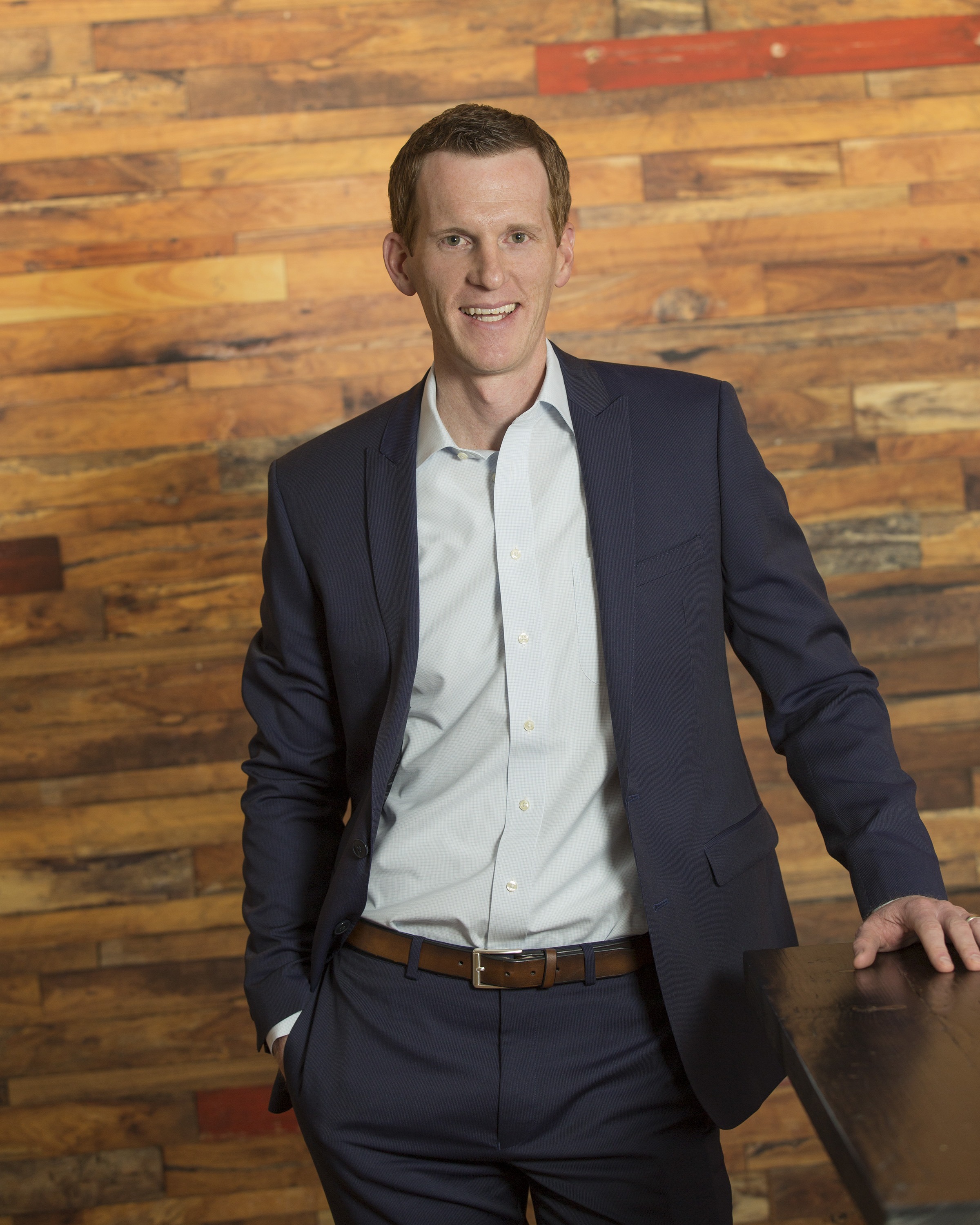
Pete Crowe
Pete leads FOCUS, an AI-enabled insurance operations partner for MGAs and P&C carriers, with 25+ years running insurance operations and 30+ carrier, MGA, and service center launches. LinkedIn